
Kettlebell Exercises Structured Into Back-Safe Workouts
Generate a back-safe kettlebell EMOM for your lower back in 60 seconds. Anterior loading by default. No Russian Twists. No American Swings. Built by a herniated disc survivor. Not a corporation.

Free forever for Full Body workouts. No credit card required. iPhone first, Android coming soon.
Most Kettlebell Apps Don't Give A Swing About Your Lower Back
Every kettlebell app you've tried throws exercises together randomly. They don't know, or care, that a Russian Twist under load combines spinal flexion, compression, and rotation simultaneously. They don't distinguish between an American Swing (lumbar hyperextension at the top) and a Russian Swing (neutral spine throughout).
If your back hurts after kettlebell swings, the problem likely isn't the swing - it's the type of swing. Russian Swings stop at chest height, keeping the spine neutral. American Swings go overhead, pushing the lumbar spine into hyperextension under load. One is a back-safe exercise. The other is a risk factor.
This app doesn't leave that distinction to chance. American Swings are excluded from generation entirely. So are Russian Twists, Sit-Up to Press, and any exercise combining loaded spinal flexion with rotation.
Excluded from every workout

Pick your muscle group, exercises, and rounds
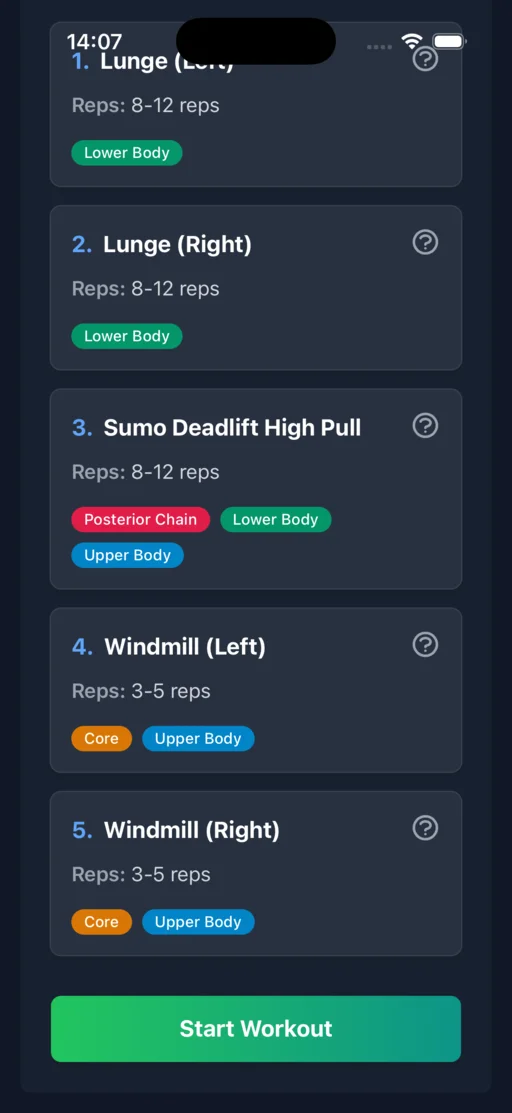
Heavy → Core → Finisher flow, every time
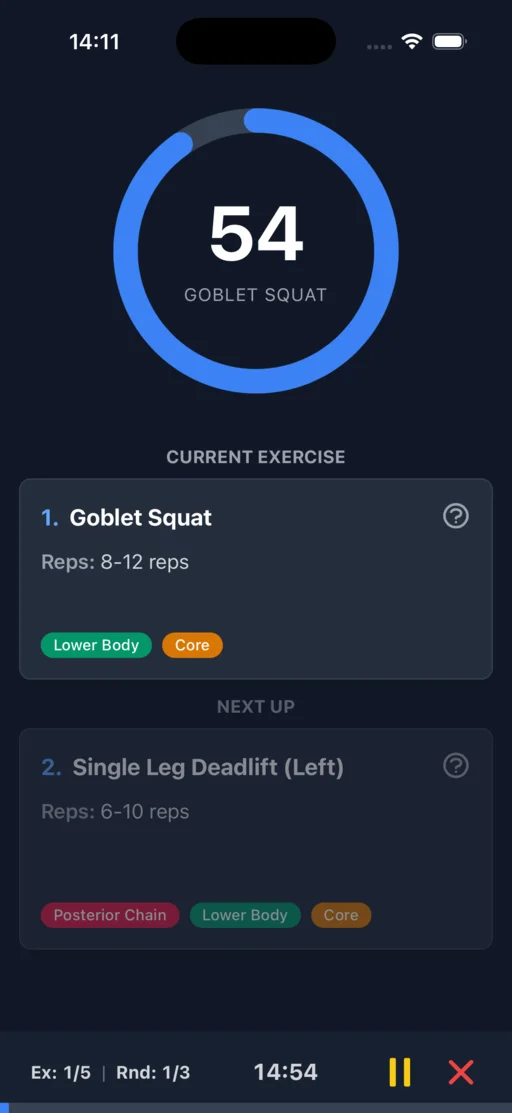
Clean EMOM timer - current exercise and what's next
Lower Back Exercises With Kettlebells: Automatically Sequenced
Every workout follows a three-stage algorithm informed by McGill & Marshall's spinal loading research. Heavy work when you're fresh. Core stability in the middle. Low impact conditioning when you're tired.
Heavy Compound
Anterior-loaded strength when form quality is highest. Goblet squats, cleans, deadlifts, presses. The algorithm weights anterior-loaded variants 2x higher, keeping the weight in front of your body to reduce spinal shear.
Core Integration
Anti-movement core exercises that stabilize the spine, not compromise it. Carries, halos and planks. Exercises that resist movement rather than create it. No loaded spinal flexion. No loaded rotation.
The Finisher
Self-limiting, low impact strength movements safe even under fatigue. Light swings, overhead marches, mountain climbers. The algorithm ensures the workout ends with exercises that can't hurt you when you're tired.
Heavy when you're fresh. Safe when you're tired. Generated and ready in under 60 seconds.

Built by the Dev Who Herniated a Disc
In 2023, a herniated disc stopped me cold. Months of physio, pointless X-Rays, MRIs, and a pinch of fear later, I was cleared to train again. But cleared didn't mean confident.
Then I switched to kettlebells. Discovered that goblet squats were painless where barbell back squats were terrifying. Found that EMOMs gave me structure: show up, press start, follow the timer. By late 2024, I was pain-free and stronger than ever before.
But every kettlebell app I tried and every YouTube workout I watched, threw American Swings and Russian Twists into my workouts. I didn't want to audit every session. So I built an algorithm informed by McGill's spinal loading research, Gullett's anterior loading biomechanics, and the anti-movement core training philosophy.
I'm a developer, not a doctor. This is personal experience, not medical expertise.
Every Exercise Is Back-Safe by Default
Every exercise in the library comes with back-safety context and form cues. Six the algorithm prioritizes most:
Goblet Squat
SafeAnterior loading keeps the weight in front of your body, reducing spinal shear compared to back-loaded squats.
Lower BodyRussian Swing
SafeChest-height arc maintains a neutral spine throughout. Unlike the American Swing, there is no lumbar hyperextension at the top.
Posterior ChainFarmer's Carry
SafeAnti-lateral flexion core training. Builds the trunk stability that protects your spine under load.
CoreHalo
SafeAnti-rotation shoulder mobility drill. Trains core stability without spinal flexion or compression.
CoreDeadlift
SafeHip hinge pattern that builds glute and hamstring strength - the muscles that protect your lower back long-term.
Posterior ChainFront Rack Lunge
SafeAnterior-loaded single-leg strength. The front rack position forces upright posture, reducing spinal compression.
Lower Body
You Own Your Kettlebells.
You Should Own Your App.
We don't believe in trapping you in endless subscriptions. Get started with unlimited Full Body workouts for free, forever.
Free Back-Safe Workouts
Unlimited access to our algorithm for Full Body EMOMs. No credit card required. No time limit.
Download on the App Store
Want to finetune your training?
If you want detailed generator options that let you prioritize specific muscle groups and movement patterns, you can upgrade to Premium right inside the app.
Upper Body
Push/pull + anti-rotation core
Lower Body
Anterior loading
Core
McGill-inspired
Posterior Chain
Hip hinge focus
Built With the r/kettlebell Community
Shaped by real feedback from kettlebell lifters. Not focus groups.
600+
downloads
Trusted by 600+ kettlebell athletes
1,000+
workouts
1,000+ structured EMOMs generated
60
seconds
from app open to workout start
Frequently Asked Questions
What are the best kettlebell exercises for lower back pain?
Are kettlebell swings safe for your lower back?
Why does my back hurt after kettlebell swings?
What is anterior loading and why does it protect the spine?
What does "back-safe" actually mean?
What is an EMOM workout?
Is this app a replacement for physical therapy?
Latest from the Blog
View allVersion 2.0.0: Protecting the Lower Back
February 26, 2026Kettlebell exercises for lower back pain, structured into a 60-second back-safe workout generator.
Why Your Back Hurts After Kettlebell Swings (And How to Fix It)
February 17, 2026Back pain after kettlebell swings usually comes from three fixable causes. Learn what's going wrong and how to swing safely for your lower back.
The Physics of Resilience: Why I Bet My Spine on 'Anterior Loading'
February 11, 2026A practical guide to anterior loading in kettlebell training for spine-friendly strength.
Train Strong. Protect Your Spine. Built for Decades.
Back-safe kettlebell workouts generated in 60 seconds. Anterior loading by default. Structure that protects.
Designed for lifters cleared to train. Based on biomechanical principles and one person's recovery experience. Not medical advice - always consult your physician.